
Wednesday, September 05, 2007

Tuesday, September 26, 2006
lord god, birdbrains

Amidst news of more circumstantial evidence of the continued existence of the Ivory-Billed Woodpecker is conclusive proof of the continued idiocy of humanity as residents of a coastal North Carolina town rush to destroy the habitat of the red cockaded woodpecker in a frantic effort to avoid becoming designated as home to the endangered species. It makes a certain sense, "If you raze it, they won't come, and we can build as many freaking houses and strip malls as we want."
Then again,
Along the roadsides, scattered brown bark is all that's left of once majestic pine stands. Mayor Joan Kinney has watched with dismay as waterfront lots across from her home on Big Lake have been gradually stripped to sandy, denuded wasteland.
"Well, it's ruined the beauty of our city," says Kinney.
Oh, can't we all just get along?
(in other news-- yes, it's run-on sentence day. now leave me alone!)
Monday, July 10, 2006
The New Adventures of Mr. Toad (Updated Millenium Version)

Image from CDC website on emerging infectious disease
Also via boingboing today, news regarding a fungus (Batrachochytrium dendrobatidis) that is killing frogs and other amphibians around the world. The fungus causes severe skin infections in every amphibian species it attacks, and the high mortality rate may lead to extinction for many species. Of course, the more mundane threats to amphibian populations still apply:
While the spread of the disease is a major new threat to all amphibians, the scientists reported that the greatest current danger to every threatened species is still the loss of habitat as cities and suburbs expand, streams and ponds and wetlands give way to the needs of farmers, and forest lands are destroyed.
It is further reported that global warming and the attendant lowering of immune response in amphibians may exacerbate the fungus-related problems. See the article "Widespread amphibian extinctions from epidemic disease driven by global warming" published in Nature on 12 January 2006.
also see:
Waiter, there's a mayfly in my beer cheese soup.

In Wisconsin, the mayflies are so thick that they are actually showing up on local weather radar as a rainstorm.
Thursday, April 27, 2006
Oh, THAT'S brilliant.
 Hey everybody, Tennessee Senator Bill Frist (R, natch) is offering you a "bold package that will give consumers some relief"! (His words, not mine.) Move over Bob Dole, there's a new man in town.
 Hot on the heels of Bush's equally brilliant announcement that he would like to waive Clean Air provisions with regard to gasoline fuel additives in an effort to reduce soaring gas prices, Senate Republicans come up with this doozy-- $100 rebate checks for everyone! That'll buy a tank of gas for my new Excursion! Oh, and while we're at it, we'll start drilling in ANWR! Wait, look over here-- don't pay any attention to the men behind the remarkably American flag-like curtain who voted for over $2 BILLION in tax breaks for oil companies just last year-- which the oil executives now say they don't need.
Meanwhile, oil companies post record profits, as do manufacturers of pharmaceuticals that promise "bold packages that will give . . . relief." Whoa!
Wednesday, April 19, 2006
We're Number One!!!
Meanwhile, everyone's asking, "Will Tom Cruise's new baby girl grow up to be as creepy as her dad?"
Friday, March 31, 2006
Wet Lands : Wetlands :: Rhetoric : Politics

Add this to the steadily accumulating pile of concrete evidence that the Bush Administration consists almost entirely of scholars of Doublespeak.
Outgoing Secretary of the Interior Gale Norton has proudly announced -- without a hint of irony -- that there has been a massive gain in US wetlands between 1998 and 2004. At first glance, that's excellent news. Unfortunately, most will stop at the first glance. A deeper look will reveal that this report depends entirely on rhetoric and semantics-- specifically, how does one define a wetland?
Does a watertrap on a golf course constitute a wetland?
Do retention ponds that collect runoff from parking lots constitute wetlands?
Do shallow, man-made ponds constitute wetlands?
Does a mine reclamation pond constitute a wetland?
In short, does the mere presence of a certain depth of water a wetland make?
According to the Bush Administration, it does. Go forth and be astonished:
- Gristmill Blog
- St. Petersburg Times
- New York Times (if you have a NY Times account)
The only thing that's wet here is the logic.
Thursday, January 05, 2006
Four-eyed trouser snake?

"We expect the sale of We to be on the same level of demand as a priceless art object," he said.Read more about the two-headed, one-stomached albino rat snake here.
Tuesday, January 03, 2006
The issue of the so-called global warmings.
 "It seems that liberals and godless tax-raisers are trying to make me look bad by using such things as 'facts' and 'scientific data.'"
Will Ferrell does a hilarious send-up of Bush on global warming at TransBuddha.com. Watch it here.
"We just need to get nature to cooperate with us. We don't need to listen to nature, nature needs to listen to us."
Thursday, December 22, 2005
Double-Mouthed Fish to be Single-Mouthed Snack.
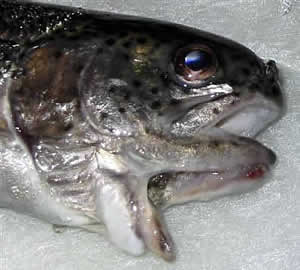
Clarence Olberding, 57, wasn't just telling a fisherman's fib when he called over another angler to look at the two-mouthed trout. It weighed in at about a pound.The above quote was from an AP report -- unfortunately, the original link is no longer available. However, since the initial post of this report, new information has come to light-- the trout's deformity was likely due to injury, not genetics . . . read more here.
The second mouth didn't appear to be functional, Olberding said. He has plans for the fish, which don't included mounting.
"I'm going to smoke it up and eat it," he said.
Thursday, November 10, 2005
The Porcupine Caribou herd is safe . . . for now.
 Common sense-- and perhaps true "conservatives"-- won out in Congress today (following section excerpted from Yahoo! News report):
Conservation-minded lawmakers cheered a US House of Representatives decision to scrap a plan allowing oil drilling in Alaska's environmentally-sensitive Arctic National Wildlife Refuge (ANWR).It's a bipartisan effort that surely would make Eisenhower proud. Yes, a Republican adminstration is responsible for establishing ANWR (then the Arctic National Wildlife Range) in 1960. It was subsequently expanded and "Range" changed to "Refuge" by the Carter administration in 1980. Now a conservative Republican administration brimming with free-market liberals wants to open up the refuge to big oil profiteers.
Negotiators wrangling over a House budget bill late Wednesday removed a provision allowing drilling in ANWR and on the Outer Continental Shelf, out of fear that its inclusion -- which faced strong opposition by some moderate representatives -- would endanger the entire budget bill.
Republican Representative Charles Bass (news, bio, voting record) gained the support of 25 lawmakers from his party and convinced the Republican leadership to give up on the provision.
It's enough to make the cranium seize.
Don't burn that bra-- nuke it!
For the woman who wants to stay both warm and environmentally conscious this winter -- and isn't bothered by extra bulk under her shirt -- a lingerie maker unveiled a thick bra that can be heated in a microwave.Read more here. Yes, there are pictures.
Triumph International modeled the bra in Japan which has launched a "Warm Biz" campaign urging people to bundle up to save on heating.
The bra pads are filled with an eco-friendly, reusable gel that can be heated up in a microwave or with hot water. For good measure, a pendant of a hot pepper dangles from the front.
Wednesday, November 09, 2005
Not surprised.
The Army Corps of Engineers and the state of Louisiana lack an overall plan for restoring coastal wetlands, a National Academy of Sciences panel said Wednesday.
"Federal, state and local officials, with the public's involvement, need to take a broader look," said Robert Dean, a University of Florida engineering professor in Gainesville who chaired a panel on the restoration efforts.
Dean said those efforts must examine "where land in coastal Louisiana should and can be restored and ... how some of the sediment-rich water of the Mississippi River should flow to achieve that."
Read more
Thursday, October 27, 2005
As I said before . . .
Wal-Mart Stores Inc., which built its reputation — and a virulent opposition — on rock-bottom prices, has talked a lot lately about becoming a kinder, more responsible company.
But the retailing giant is finding that convincing the world that it is "committed to change," and to keeping costs low, is a tough balancing act.
On Monday, Chief Executive H. Lee Scott Jr. pledged to bring health insurance within reach of his 1.3 million U.S. employees. On Wednesday, a leaked company memo revealed "bold steps" to reign in Wal-Mart's employee benefit costs.
Among the recommendations: using more part-time workers, cutting life-insurance payouts, pushing spouses off health plans through higher premiums and trying to dissuade unhealthy people from seeking jobs by, among other things, requiring cashiers to gather carts in Wal-Mart's vast parking lots.
Tuesday, October 25, 2005
Wal-Mart Trades Yellow Smiley for Green One?
Anyway.
Here's an excerpt from today's AP report:
Tom Rubel, who heads consultant Retail Forward in Columbus, Ohio, said Scott was leading a genuine effort to adopt new standards.
"I do think that this is a departure. This is sort of vintage Wal-Mart. They have listened, and learned, and now they have set a course and they've established some aggressive goals and now they're going to go after it very aggressively," Rubel said.
Scott said the environmental plan was part of goals set after a year of talks with Wal-Mart's employees, customers and critics that he said showed many of the issues where the company was on the defensive could be opportunities instead.
Scott said those meetings did not include any labor unions or groups such as Wal-Mart Watch and Wake Up Wal-Mart, formed in the past year to coordinate campaigns against the retailer by labor, environmental, women's rights and community groups.
"We met with people who quite honestly have asked us not say who they are. We did not meet with those people who simply wish we did not exist as a company," Scott said when asked about the two campaign organizations. Wal-Mart Watch and Wake Up Wal-Mart say they want to reform the company, not shut it down.
Wal-Mart's targets for raising fuel and energy efficiency and reducing packaging waste are bold but the credibility will depend on whether the company reports its progress to the public, one environmental expert said.
"Wal-Mart is one of the world's largest companies in the world so they have a huge influence in the marketplace. There is a huge opportunity for them to influence the marketplace," said Elizabeth Cook, vice president of World Resources Institute in Washington D.C.
"Wal-Mart will win its skeptics over once it shows that it can deliver on these commitments," she added.
I'm going to be a good steward of oxygen and not hold my breath.
Friday, October 21, 2005
I Don't Send Me Flowers Anymore.
Thursday, September 01, 2005
The conversation.
Yesterday I wondered what would happen to the Katrina Conversation. Here's where it's going today:
- Sidney Blumenthal points a finger at the Bush Administration in the German press (Spiegel online) and at Salon.com for cutting funding to New Orleans flood control funding and encouraging development of wetlands. According to Blumenthal, in 2001, FEMA warned that a hurricane striking New Orleans was one of the three most likely disasters facing the US (one of the other top three was a major terrorist attack on NYC, and this was early 2001). Wonder what the other was? Looks like FEMA's two for three.
- David Brooks wonders about the "human storm" following the hurricane in an editorial at the NY Times. He points out some disturbing similarities between the great Mississippi flood of New Orleans in 1927 and the aftermath of Katrina-- namely, the racial and class disparity regarding who has been left behind:
take a close look at the people you see wandering, devastated, around New Orleans: they are predominantly black and poor. The political disturbances are still to come.
- The general editorial at the NY Times seems to call for sacrifice on the part of all Americans -- something that perhaps sounds odd to our pampered ears. After 9/11, we were encouraged to go forth and spend money to stimulate the economy, rather than tighten our belts and sacrifice for our fellow humans (as Americans were advised to do when America joined the fray in WWII). Victory garden? No. Victory trip to the mall! The same editorial then asks some very pointed and hard questions for keeping the Conversation going, questions that must be asked, that should have been asked prior to this disaster, and that demand answers in the coming weeks and months, namely:
While our attention must now be on the Gulf Coast's most immediate needs, the nation will soon ask why New Orleans's levees remained so inadequate. Publications from the local newspaper to National Geographic have fulminated about the bad state of flood protection in this beloved city, which is below sea level. Why were developers permitted to destroy wetlands and barrier islands that could have held back the hurricane's surge? Why was Congress, before it wandered off to vacation, engaged in slashing the budget for correcting some of the gaping holes in the area's flood protection?
- The Rev. Isaac Clark, speaking amidst the chaos from the New Orleans Convention Center, wonders where the aid is: "We are out here like pure animals. We don't have help." R Neal at Facing South wonders the same thing, and gives contact information for Congresspeople. Neal (SKB) references a MSNBC correspondent reporting from NOLA:
The reporter said that she had been there four days. She said she has heard about all the provisions that the federal government had rushed to the scene, but says that she and her crew have not seen any of it. Nothing. People are dying there. They are begging for help.
Wednesday, August 31, 2005
The wisdom of dialogue.
Today's class was something of a free-for-all, and discussion was wide-ranging, but there was one thing in particular that I found quite thought-provoking. One of my classmates mentioned that environmental problems (in America) aren't as dramatically apparent today as they once were-- we don't have a burning river like Cuyahoga in 1969 to point to as a horrifying empirical demonstration of the direct harm that we can do when we make poor choices regarding business practices, etc.-- and that perhaps this lack of drama leads to disinterest in environmental responsibility. But it strikes me that right now, at this very moment, we have the equivalent of a burning river (or several burning rivers, or worse) down South in Louisiana, Mississippi, Alabama, and Florida.
Despite the statements already issued by right wing religious nutjobs regarding the "ultimate message" behind the hurricane (it was an Act of a vengeful God intended to call our attention to the sinfulness of our ways), it would seem that this particular hurricane is NOT an isolated event, but rather is part of a long-term pattern of change with regard to our climate. In other words, the frequency and increased severity of hurricanes over the past decade may be not only correlative with a warming planet, but there may be a causal relation as well. If this is so, then we are, in a very broad sense, partially responsible for the extent of the destruction and the suffering currently being felt in the Deep South. We have (in a sense) brought this disaster upon ourselves and our neighbors through decades (centuries, even) of poor choices with regard to our environment. And inevitably, and alarmingly, there is more to come.
It is, of course, disturbing (to say the least) that this particular conversation is starting so late in the game and only AFTER the major disaster and devastation has already occurred. Why do we loathe preventive medicine so? But don't worry, the conversation will hardly get started before it's forgotten.
There will be enough naysayers to table this line of thought quite quickly-- we've experienced Category 5 hurricanes before, this isn't unprecedented, remember Camille, etc. Eyes will be effectively drawn away from the observed trends in climate change across time, and we'll focus on this as an isolated event, even though it's not. And then we'll focus on the triumph of the human spirit in the face of disaster. The responsibility for climate change conversation is too abstract to hold our interest for long-- if we can't find a scapegoat for our troubles, or if we have to diffuse responsibility across peoples and generations, or if the only solution is to radically examine and quite possibly alter our current lifestyles, forget about it.
OK then, what about the levee system? Before Katrina struck, I remember reading something about the irony of the levee and drainage system of New Orleans-- sure, it protects the city from regular flooding of rivers, including the Mississippi, but it also interferes with the natural process of sedimentation that feeds the system of bayous and swamps that help coastal and floodplain areas recover from severe flooding. Without the levees, there is flooding; with the levees, there is less frequent flooding, but the land is less able to recover from severe flooding, as is the case currently. Further, after someone figured out how to drain the swampy areas of NOLA into the canals and levees, the city expanded into lower areas that are even more vulnerable to and unable to recover quickly from severe flooding. It's no surprise that the areas of the city that are experiencing less flooding (French Quarter, etc) are the older areas of New Orleans, built before the modern levee/canal/drainage technologies were implemented. So here again, we have an opportunity to reevaluate choices we have made with regard to environmental and urban planning-- and a less abstract case of cause and effect to reference.
But of course, as my classmates pointed out to me when I was waxing on about how I am interested to see how the conversation r.e. NOLA, MS, and AL plays out (and whether such disaster will call our attention to environmental problems and better solutions), OF COURSE they will simply come up with better, stronger levee/canal/drainage technology. More levees! We'll rebuild it! We will make it better, stronger!
And so this futile struggle of humans versus nature will continue unabated and unexamined, because there is something that we value deeply about rebuilding in the face of disaster, rather than taking our lumps and moving on elsewhere -- say, to higher ground. To do other than rebuild would be to let the terrorists, um, mother nature win. To do other than rebuild would mean that we were wrong, or weak, or inferior. We would be giving up our privileged place as God's chosen people, or as the highest forms of life, etc. We would be admitting that we are a part of, not apart from, nature and its processes. We must rebuild, and in so doing, ensure our complete annihilation at some point in the future. Absurdity, futility.
We absolutely refuse to accept that there might be some places we simply aren't meant to live. I'm reminded of the ancient wisdom that encouraged people to not build their houses on the sand, and I wonder what happened to that wisdom? Has technology replaced common sense? If we can build it, should we? Must we?
I continue to wonder what will happen to these potential conversations-- the conversations about the choices we make and our responsibility for their outcomes (and NO, I am most certainly not referring to divine punishment for providing women with a full range of gynecological care). The incident at Cuyhoga started a conversation that led to a focus on cleaning up the nation's rivers, and ultimately to the Clean Water Act. What will the Katrina conversation(s) lead to? More of the same?
Thursday, August 25, 2005
The price is definitely NOT right.
A recent study by researchers at the University of California-Davis reported that U.S. shoppers who consistently choose healthy foods spend nearly 20 percent more on groceries. The study also said the higher price of these healthier choices can consume 35 to 40 percent of a low-income family's grocery budget. That's bad news for public health. It's also bad news for the organic-food market, since organics usually carry the highest price tag of all the healthy stuff out there.
The above quote comes from today's Grist article, "Cost in Translation," about the high costs of eating organic food. What's alarming to me is that organic is merely a subset of "healthy foods"-- and the study reports that shoppers who choose healthy foods (not just organic) spend a great deal more on groceries than other folks.
What does this mean for people with tight incomes and demanding schedules? As a grad student, I find myself picking up fast food much more frequently than I did as a corporate "professional." It's cheaper and, well, faster -- and I don't have to spend time wedged into my 3x3 "kitchen" for time consuming prep and clean-up (ever tried to make a "well-balanced meal" in a coat closet?). As a result, I feel less healthy and I've put on a few pounds more than I would like.
What does this mean? People who can't (or can barely) afford insurance or healthcare are also those who are unable to afford some of the best "preventive medicine" available -- healthy food. Or they're unable to find it because their local groceries don't stock it, or stock spoiled or spoiling produce and other perishable goods. It's a vicious cycle that keeps people poor, fat, and sick.
You can read a brief of the UC Davis study in pdf format here: http://aic.ucdavis.edu/pub/briefs/IB%2029.pdf
Here's an excerpt:
An alarming increase in such chronic diseases as obesity, diabetes, cardiovascular disease, hypertension and stroke, and some types of cancer has occurred over the past decade (Kant 2004). Improving diet quality by eating more whole grains and fruit and vegetables, and by eating less fat and refined sugar could help lower the incidence or severity of these diseases.
Avoiding and managing chronic disease, not surprisingly, is (and has been for quite some time) a class issue. It used to be that people couldn't afford food-- now they can't afford the right foods.
Can't afford the foods that help you avoid chronic disease? Can't afford to spend leisure time exercising (translation: don't have leisure time because you're working two jobs to pay your rent)? Can't afford healthcare, medicine and treatment for the chronic disease you developed because you were too cash- and time-strapped to avoid it? Too freaking bad. It's probably your fault anyway. Maybe you're a sinner, or stupid, or lazy.
It seems that people assume that overweight and obese people deserve to be unhealthy because they have made poor choices regarding their health. I've even heard people remark that overweight, poor people must not be that poor, as they clearly have been able to afford the food that has made them overweight. What, are poor people supposed to starve themselves to be authentic? In times past (and still in some cultures), obesity was a mark of prosperity -- gout was the rich man's disease. Not so these days, when a stick-thin figure is a sign of wealth and the ability to afford a personal trainer and dietician. It's McDonald's that has the dollar value menu, not Spago or the new raw food restaurants cropping up in urban areas across the nation. Even more alarming is the fact that I could spend $1 for a double cheeseburger, or $1 for one (1) non-organic red bell pepper at the grocery. That just doesn't make sense.
Of course, if you add up the hidden costs of consuming that $1 double cheeseburger (healthcare, environmental damage, labor costs, etcetera), it costs much more than the bell pepper-- but that's not what I'm thinking about two weeks into the month when most of my paycheck has been parceled out to my creditors and I still have to feed myself (and if I'm lucky, my children and my pets and my spouse). It's about that time that one's tolerance for well-meaning theory goes out the window, and one wishes that the hippies would shove their "joys of organic gardening" and saving the environment and the animals crap up their collective ass. Now there's a dilemma for you ethicists. So solve it, already.
